


Why EN 45545-Certified Nylon Flexible Conduit Is the Smart Choice for Railway Cable Protection
Introduction: The Hidden Risk Inside Every Train
When passengers board a train, their attention goes to seat comfort, Wi-Fi connectivity, and arrival times. What they never see — but depend on entirely for their safety — is the thousands of meters of electrical wiring running through the walls, floors, and ceilings of every rail vehicle.
Cable protection in railway environments isn't simply an engineering detail. It's a life-safety requirement.
Fires on trains spread faster than in open environments. Smoke fills enclosed cabins within minutes. And in tunnels, evacuation options are severely limited. This is exactly why railway engineers, rolling stock manufacturers, and procurement teams around the world have a non-negotiable demand: every component used in cable routing must meet strict fire protection standards — including the conduit protecting those cables.
This article explores why EN 45545-certified non-metallic flexible corrugated tubing — specifically PA6 nylon conduit — has become a preferred solution for cable protection in modern railway and transit systems, and what specifications procurement teams should look for when sourcing.
The EN 45545 Standard: What It Means and Why It Matters
EN 45545 is the European standard for fire protection on railway vehicles. It replaced a patchwork of country-specific national standards (such as Germany's DIN 5510-2, France's NF F 16-101, and the UK's BS 6853) when it came into effect in 2013, and is now mandatory for all rolling stock manufacturers and suppliers operating in the European market.
The standard is divided into multiple parts, with two being directly relevant to cable conduit selection:
EN 45545-2 — Defines material requirements for fire behavior, covering flammability, smoke density, and toxic gas emissions. Materials are classified into Hazard Levels (HL1 through HL3), where HL3 represents the most demanding environments — typically trains operating through long tunnels or underground systems.
EN 45545—3Covers fire resistance requirements for fire barriers and penetration seals.
ForTrBogie and Underfloor Cable Runsain Cabin Interiors cable conduit specifically, Requirement Sets R22 (interior) and R23 (exterior) under EN 45545-2 are the key benchmarks. Products must demonstrate they will not ignite easily, will not produce dense smoke that obscures evacuation, and will not release toxic gases that could incapacitate passengers or emergency responders.
TheWiring for passenger information systems, lighting controls, air conditioning, and entertainment systems runs through cabin ceilings, walls, and under seats. This environment requires UL 94 V-0 rated, halogen-free conduit to ensure that, in a fire event, the conduit does not contribute to smoke toxicity in the enclosed passenger space. UL 94 flammability rating system — widely used in North American product certification — maps broadly to these requirements. A UL 94 V-0 rating (self-extinguishing within 10 seconds, no dripping of flaming particles) is the performance threshold aligned with railway fire safety expectations.
Why Non-Metallic PA6 Conduit Outperforms Metal in Rail Applications
Traditional thinking often defaults to metal conduit for "serious" industrial applications. But in modern rail vehicle design, nylon corrugated flexible conduit made from Polyamide 6 (PA6) offers a compelling set of advantages that metallic alternatives cannot match.
1. Vibration and Shock Resistance
Railway vehicles are in constant motion. Wheel-rail contact generates continuous vibration, and every curve, switch, or braking event introduces mechanical shock. Metal conduit, particularly at fittings and connection points, is susceptible to loosening, cracking, or fatigue failure over time under these conditions.
PA6 nylon conduit has inherent elasticity and toughness that absorbs vibration rather than transmitting it. The corrugated structure distributes mechanical stress along the conduit's length, making it exceptionally durable in the dynamic environments found in bogies, underfloor cable runs, and cabin door systems.
This is also why EN 61373 — the vibration and shock testing standard for railway equipment — is a key evaluation criterion for any component installed on rolling stock.
2. Weight Reduction
Weight is a critical engineering consideration in rail vehicle design. Lighter vehicles consume less energy, reduce track wear, and support higher speeds. Replacing metallic conduit with PA6 nylon conduit delivers a measurable reduction in cable management system weight without sacrificing protection performance.
3. Flexibility in Confined Spaces
Train cabins, underfloor compartments, and equipment bays are among the most space-constrained wiring environments in any industry. High-flexibility nylon corrugated conduit allows routing around corners, through tight bends, and across moving joints (such as articulated connections between carriages) without the rigid structure limitations of metal conduit.
The corrugated design maintains a minimum bend radius while keeping the internal cable pathway clear and unrestricted — essential for protecting wire harnesses in high-density wiring areas.
4. Corrosion and Chemical Resistance
Railway vehicles are exposed to rain, humidity, tunnel condensation, brake dust, cleaning chemicals, and road salts in urban environments. PA6 nylon conduit is naturally resistant to oils, fuels, and most industrial chemicals, and does not corrode. This translates directly into lower maintenance requirements and longer service life.
5. IP66 Dust and Water Protection
When paired with compatible nylon fittings, properly configured PA6 corrugated conduit systems achieve IP66 ingress protection — protecting cable systems against powerful water jets and complete dust exclusion. This is particularly critical for underfloor cable runs and exterior-mounted components exposed to harsh weather and wash-down procedures.
Key Specifications to Require from Your Conduit Supplier
When specifying non-metallic flexible conduit for railway applications, procurement engineers and project managers should verify the following:
| Specification | Railway Requirement | What to Look For |
| Fire Certification | EN 45545-2 / EN 45545-3 | Verified compliance certificate with test reports |
| Flammability Rating | UL 94 V-0 (or V-2 for lower-risk zones) | Clearly stated in product datasheet |
| Temperature Range | Wide operating range for global deployment | Minimum -40°C to +105°C |
| IP Rating | IP66 minimum for exterior/underfloor | Confirmed with fitting combination |
| North American Compliance | UL1696 / CSA C22.2 No. 227.3 | For projects in the US, Canada, or global OEMs |
| Environmental | RoHS / Halogen-Free | Essential for passenger safety in enclosed spaces |
| UV Resistance | Required for exterior or roof applications | Confirmed in product specification |
A supplier that can provide both EN 45545 and UL1696/CSA certification on a single product line is particularly valuable for global rolling stock OEMs who need to manage a single, consolidated bill of materials across projects in multiple regulatory regions.
Application Scenarios: Where Nylon Flexible Conduit Is Used in Rail Vehicles
Understanding the specific locations where flexible conduit is deployed in rail vehicles helps procurement teams match product specifications to installation conditions.
Train Cabin Interiors
Wiring for passenger information systems, lighting controls, air conditioning, and entertainment systems runs through cabin ceilings, walls, and under seats. This environment requires UL 94 V-0 rated, halogen-free conduit to ensure that, in a fire event, the conduit does not contribute to smoke toxicity in the enclosed passenger space.
Bogie and Underfloor Cable Runs
The bogie — the wheeled assembly beneath a rail vehicle — is one of the harshest electrical environments imaginable. High vibration, extreme temperature cycling, exposure to water and road contamination, and continuous mechanical movement demand conduit with exceptional flexibility, IP66 protection, and long-term fatigue resistance.
Door Control Systems
Powered passenger doors cycle thousands of times per day. Wiring for door motor controllers, safety sensors, and emergency releases must be protected by conduit that can flex repeatedly without wear — a direct match for the properties of high-flexibility corrugated PA6 tubing.
Tunnel Wiring and Track-Side Infrastructure
Fixed electrical installations in tunnels — signaling systems, emergency lighting, communication cables — face the combined challenges of high humidity, poor ventilation, and severe fire risk. EN 45545-2 compliance at HL3 hazard level is the appropriate specification for these applications.
Gangway Connections Between Carriages
The flexible connection between adjacent carriages is a dynamic routing challenge. Cable harnesses must accommodate continuous articulated movement while maintaining full protection. High-flexibility nylon corrugated conduit, combined with properly engineered fitting connections, is an established solution for this application.
Nylon Flexible Conduit
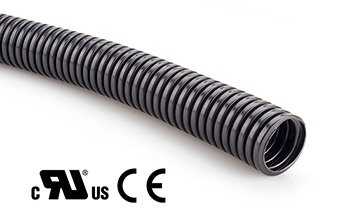
Nylon Flexible Conduit Is the Smart Choice for Railway Cable Protection
✔ UL1696 Certified | ✔ EN-45545-2, EN-45545-3 standard
Why Kaiflex PAFS/PACS Series Meets These Requirements
Kaiflex's PAFS/PACS Series Non-metallic Mechanical Protection Tubing was engineered with the demanding requirements of rail and transit applications in mind.
The product holds UL1696 certification (cURus, File No. E491228) for the North American market, and has been verified against EN 45545-2 and EN 45545-3 standards — making it one of the few PA6 nylon conduit products in the market to carry cross-regional compliance credentials on a single product series.
Key performance characteristics include:
- Material: Polyamide 6 (PA6) — high mechanical strength, toughness, and attrition resistance
- Temperature range: -40°C to +105°C, covering both arctic deployment conditions and high-temperature equipment compartments
- Flammability: UL 94 V-0 and V-2 rated variants available
- IP Rating: IP66 when paired with FN01–FN04 fitting series
- Halogen-free and RoHS compliant — safe for enclosed passenger environments
- UV resistant — suitable for exterior and roof-mounted applications
- Size range: 10mm to 54mm nominal conduit size, covering the full spectrum from small signal wiring to large power distribution harnesses
The corrugated PA6 construction delivers the flexibility needed for routing in confined spaces and through continuously moving components, while the certification credentials satisfy compliance documentation requirements for railway procurement processes across Europe, North America, and global OEM supply chains.
Procurement Considerations: Getting Compliance Documentation Right
Railway procurement processes place significant emphasis on traceability and documentation. When evaluating conduit suppliers for rail projects, it is advisable to request:
1. Certificate of compliance referencing the specific EN 45545 test standard and hazard level achieved
2. UL certification file number (for North American or UL-specified projects)
3. Material safety data confirming halogen-free composition
4. RoHS declaration of conformity
5. Product test reports for flammability, smoke density, and toxicity if HL3 compliance is required
Suppliers with established quality management systems and the ability to provide consistent documentation across production batches are significantly easier to work with through the demanding validation processes that railway OEM procurement teams operate.
Conclusion: Certification Is Not Optional in Railway Applications
Selecting cable conduit for railway applications is not a decision where "good enough" is acceptable. EN 45545 compliance is a legal and contractual requirement across the European rolling stock market. UL1696 certification is the baseline expectation for North American transit projects. And the consequences of selecting non-compliant components — both in safety terms and in project approval delays — are severe.
Non-metallic PA6 nylon corrugated flexible conduit, when properly certified and correctly specified, delivers the combination of fire safety, mechanical durability, flexibility, and ingress protection that modern rail vehicle design demands. It replaces heavier, less flexible metallic alternatives while meeting or exceeding the regulatory requirements that govern the industry.
For rolling stock OEMs, rail infrastructure contractors, and system integrators evaluating cable protection solutions, Kaiflex PAFS/PACS Series offers a technically validated, cross-certified option backed by documented compliance credentials.



Looking for high-fit metal or non-metal conduits and fittings?