


A Complete Guide to Flexible Metal Conduit Fittings: Types, Standards & Applications
Flexible Metal Conduit Fittings: Types, Standards & How to Choose
Flexible metal conduit fittings are the connectors that join flexible metal conduit (FMC) to junction boxes, enclosures, motors, and other equipment entries in an electrical wiring system. While the conduit itself protects cables along their run, it's the fitting that determines whether that protection actually holds up at every connection point — against pull-out force, moisture ingress, vibration, and long-term corrosion.
Because flexible metal conduit fittings are specified against different regional and industry standards, choosing the right one starts with understanding which standard applies to your project, and which fitting family within that standard fits the installation environment.
Why the Fitting Matters as Much as the Conduit
A conduit run is only as protective as its weakest connection. An undersized or incorrectly rated fitting can allow moisture ingress in outdoor installations, loosen under vibration in industrial machinery, or fail a certification audit even when the conduit itself is fully compliant. This is why fittings are certified and tested as their own product category, separate from the conduit — and why buyers should evaluate fitting specifications (thread type, sealing method, material, certification) with the same care as the conduit itself.
Flexible Metal Conduit Fitting Standards by Region
UL1 (USA/Canada) — Dry-Location Fittings
UL1 covers flexible metal conduit and fittings for general building wiring in dry, indoor environments — lighting circuits, office wiring, and machinery in non-wet locations. Fittings under this standard are typically set-screw, screw-in, or squeeze (duplex) type, made from zinc alloy or steel. See our UL1 Listed Flexible Metal Conduit & Fittings range.
UL360 (USA/Canada) — Liquid-Tight Fittings
UL360 covers liquid-tight flexible metal conduit and fittings, used with PVC-jacketed conduit in outdoor, washdown, and wet-location installations requiring an IP66/IP67 seal — common in food processing, outdoor equipment, and wastewater facilities. See our Liquid Tight Flexible Metal Conduit & Fittings (UL360) range.
AS/NZS 2053 (Australia/New Zealand)
AS/NZS 2053 is the joint Australian and New Zealand standard for conduits and fittings for electrical installations. The relevant part for flexible metal and composite conduit is AS/NZS 2053.8, which specifies requirements for non-threadable flexible conduit and fittings. Note that the industry is gradually transitioning toward AS/NZS 61386 (aligned with IEC 61386), so it's worth confirming which standard a given project specifies. See our AS/NZS Flexible Metal Conduit & Fittings range, including square-lock galvanized and stainless steel conduit with quick-assembly fittings.
IEC 61386 (Europe and International)
IEC 61386 is the international standard framework for conduit systems, widely referenced across Europe and adopted or harmonized in many other markets. See our EU Flexible Metal Conduit & Fittings range.
Explosion-Proof Fittings (UL/IECEx)
For hazardous locations in oil & gas, chemical processing, and mining, flexible couplings and adapters must meet explosion-proof ratings on top of the base conduit standard. See our Explosion Proof Flexible Coupling & Adapter range.
Common Flexible Metal Conduit Fitting Types
-
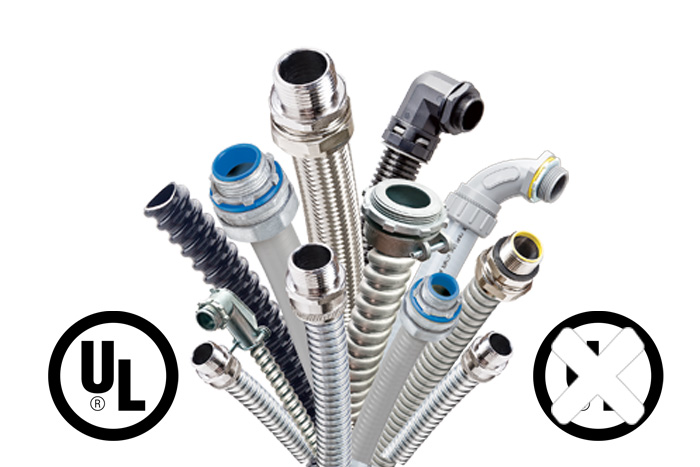
Straight fittings — the most common type, connecting conduit to a box or enclosure in a single, direct run.
-
90-degree (angle) fittings — used where the conduit needs to turn a corner immediately at the connection point, saving space in tight enclosures.
-
Set-screw fittings — secured by tightening screws against the conduit body; economical and widely used in UL1 dry-location work.
-
Squeeze (duplex) fittings — clamp around the conduit for a faster, tool-light installation.
-
Liquid-tight fittings — include a sealing ring or gasket to achieve IP66/IP67 ratings for wet or outdoor locations.
-
Quick-assembly fittings — designed for faster installation in high-volume projects, common in AS/NZS-market products.
Materials Used in Conduit Fittings
Most flexible metal conduit fittings are die-cast from zinc alloy (cost-effective, corrosion-resistant for general use) or steel (higher mechanical strength for demanding environments). Stainless steel fittings are used where corrosion resistance is critical — food processing, marine, or chemical-exposure environments.
How to Choose the Right Flexible Metal Conduit Fitting
-
Identify the applicable standard for your market and project (UL1, UL360, AS/NZS 2053, IEC 61386, or explosion-proof).
-
Match the environment — dry indoor wiring calls for UL1-type fittings; outdoor, washdown, or wet locations call for liquid-tight (UL360) fittings.
-
Confirm thread size and trade size against the conduit and the enclosure knockout you're connecting to.
-
Check certification documentation — UL File Numbers, CSA certification, or the relevant AS/NZS or IEC compliance records — especially for regulated installations.
-
Consider material based on the corrosion and mechanical stress the fitting will see in service.
Frequently Asked Questions
What is a flexible metal conduit fitting?
A flexible metal conduit fitting is a connector used to attach flexible metal conduit (FMC) to a junction box, enclosure, or equipment entry, securing the conduit while maintaining electrical continuity and mechanical protection for the wiring inside.
What's the difference between UL1 and UL360 fittings?
UL1 fittings are for dry-location, general building wiring. UL360 fittings are liquid-tight, designed for outdoor, washdown, or wet-location installations requiring an IP66/IP67 seal.
Is AS/NZS 2053 still the current standard in Australia and New Zealand?
AS/NZS 2053 has historically been the foundational standard, but the industry is transitioning toward AS/NZS 61386, which aligns with the international IEC 61386 standard. Check your project specification to confirm which applies.
What material should I choose for a corrosive or marine environment?
Stainless steel fittings offer the best corrosion resistance for marine, food-processing, or chemical-exposure environments; zinc alloy or steel fittings are suitable for general indoor and outdoor use.
Does Kaiflex manufacture fittings for multiple regional standards?
Yes — Kaiflex produces flexible metal conduit fittings certified to UL1, UL360, AS/NZS 2053, and IEC 61386, plus explosion-proof couplings for hazardous locations. Contact our team for a project-specific recommendation.
Looking for high-fit metal or non-metal conduits and fittings?