


Stainless Steel Square Lock + Stainless Steel Braiding
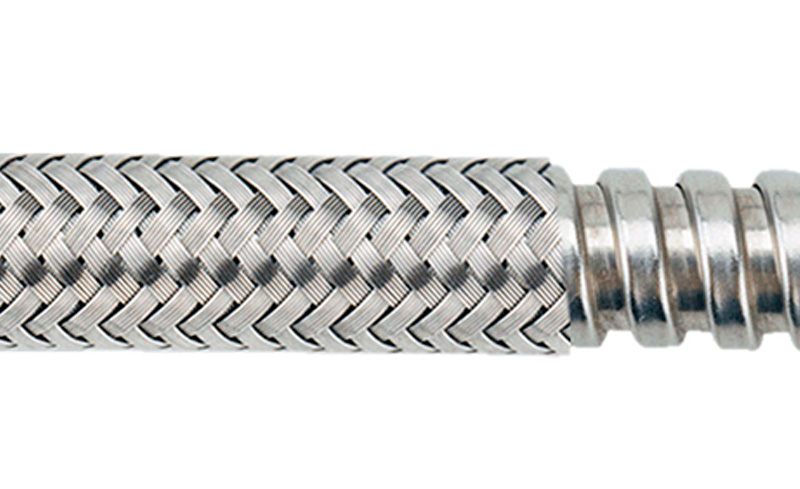
Flexible Electrical Conduit, WP-S1SB series is manufactured with stainless steel strip by continuous wound in square lock profile. The size range of this series of flexible tube is ID 3.5~16.1mm. It is featured with excellent flexibility and its miniaturized diameter makes the tube be light and also pressure resistance. That offers benefit for deployment in complex or narrow spaces. As for the demand of high abrasion resistance or preventing the interference of microwave or static electricity in the environment (EMC shielding), electrical flexible conduit with metal mesh braiding is the proper one to choose.
Specially applicable for protection of signal wire on tools, automation system or equipment, robot, access control and security system and etc..
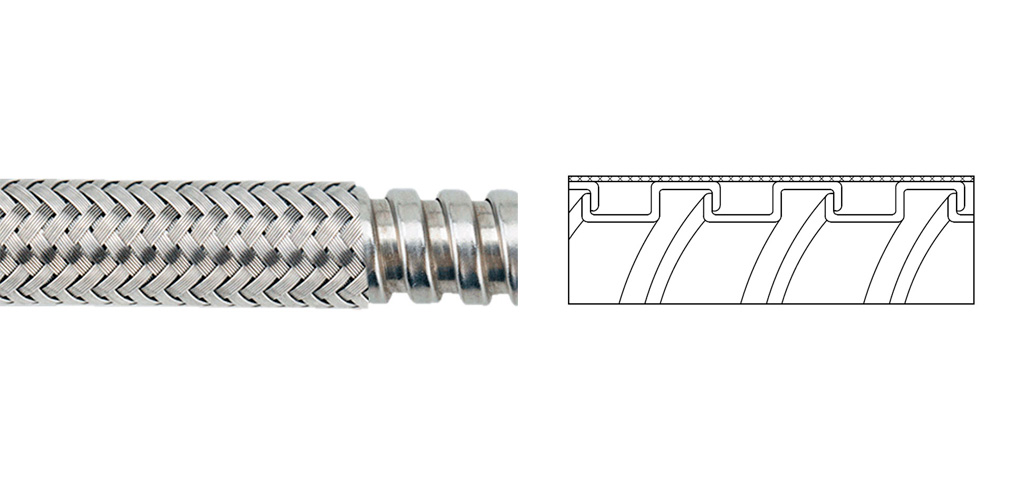

Feature
-

Material:
Stainless Steel Square Lock + Stainless Steel Braiding -
Temperature Range:
-40℃~350℃ -
IP Rating
IP 40 -
Flexibility:
Medium -
EMC Shielding
Standard -
RoHS Compliance :
Yes -
Standard:
Follow IEC standard, 2~3 joints are allowed in a length of 100M.
Parameter
| Part Number | ID (mm) | OD w/Braiding (mm) | Bending Radius (mm) | Tensile Resistance (kg) | Package/Roll (m) |
|---|---|---|---|---|---|
| P035060S1SB | 3.5±0.2 | 6.0±0.25 | ≤45 | ≥35 | 200 |
| P040070S1SB | 4.0±0.2 | 7.0±0.25 | ≤50 | ≥50 | 200 |
| P045075S1SB | 4.5±0.2 | 7.5±0.25 | ≤50 | ≥50 | 200 |
| P050080S1SB | 5.0±0.2 | 8.0±0.25 | ≤50 | ≥50 | 150 |
| P055085S1SB | 5.5±0.2 | 8.5±0.25 | ≤50 | ≥50 | 150 |
| P060090S1SB | 6.0±0.2 | 9.0±0.25 | ≤50 | ≥50 | 150 |
| P065095S1SB | 6.5±0.2 | 9.5±0.25 | ≤50 | ≥50 | 100 |
| P070100S1SB | 7.0±0.2 | 10.0±0.25 | ≤50 | ≥60 | 100 |
| P075105S1SB | 7.5±0.15 | 10.5±0.25 | ≤50 | ≥60 | 100 |
| P080110S1SB | 8.0±0.2 | 11.0±0.25 | ≤50 | ≥65 | 100 |
| P090120S1SB | 9.0±0.2 | 12.0±0.25 | ≤55 | ≥70 | 100 |
| P100130S1SB | 10.0±0.2 | 13.0±0.25 | ≤60 | ≥80 | 100 |
| P115153S1SB | 11.5±0.2 | 15.3±0.25 | ≤75 | ≥80 | 50 |
| P125170S1SB | 12.5±0.3 | 17.0±0.35 | ≤95 | ≥80 | 50 |
| P144191S1SB | 14.4±0.3 | 19.1±0.35 | ≤100 | ≥90 | 50 |
| P161208S1SB | 16.1±0.3 | 20.8±0.35 | ≤105 | ≥120 | 50 |
Frequently Asked Questions
What is the WP-S1SB stainless steel square lock with braiding?
The WP-S1SB series is a miniaturized stainless steel flexible conduit with square lock profile and protective stainless steel braiding mesh. It combines exceptional corrosion resistance, EMC electromagnetic shielding, abrasion protection, extended temperature range (-40℃~+350℃), and compact size (3.5-16.1mm ID), ideal for precision signal wires in robots and high-EMI environments.
What is EMC shielding and why is it important?
EMC (Electromagnetic Compatibility) shielding prevents electromagnetic interference (EMI) from external sources and prevents signal wires from radiating interference to other equipment. The stainless steel braiding mesh creates a Faraday cage around the conduit, essential for precision sensors, encoders, and control systems in robots operating near high-power equipment or RF sources.
What size range is available?
WP-S1SB offers 16 sizes ranging from 3.5mm to 16.1mm inner diameter. Part numbers include P035060S1SB through P161208S1SB, allowing precise matching to signal wire bundles from small sensor cables to larger robot motor signal lines.
What is the temperature range?
WP-S1SB operates reliably between -40℃ and +350℃, providing exceptional temperature performance suitable for extreme cold, high-temperature industrial applications, and thermal cycling. This extended range is superior to PVC-jacketed alternatives and enables use in furnace areas and cold storage with the same conduit.
What is the IP rating?
WP-S1SB has an IP40 rating in bare form. The stainless steel braiding provides mechanical protection and abrasion resistance but does not seal against liquids. For applications requiring water protection, WP-S1P2 (PVC jacket) is recommended instead.
What material and profile are used?
WP-S1SB is manufactured from stainless steel strip wound in a square lock profile with stainless steel braiding mesh overwound. The square lock provides exceptional mechanical strength and flexibility, while the stainless steel braiding delivers EMC shielding and abrasion resistance.
What is the bending radius and flexibility?
WP-S1SB features medium flexibility with bending radii ranging from ≤45mm (smallest 3.5mm size) to ≤105mm (largest 16.1mm size). While the braiding adds slight stiffness compared to bare conduit, flexibility remains excellent for routing in robotic applications.
What is the tensile resistance?
Tensile resistance ranges from ≥35kg (smallest 3.5mm size) to ≥120kg (largest 16.1mm size). The stainless steel braiding adds mechanical reinforcement, ensuring durability under stress, vibration, and repetitive flexing in robotic applications.
What are the typical applications for WP-S1SB?
WP-S1SB is ideal for signal wire protection in industrial robots near RF sources, CNC machines with spindle interference, precision servo systems, encoder cables, motion control systems, high-frequency switching equipment, semiconductor manufacturing tools, and any application requiring EMC shielding and abrasion resistance.
Why is braiding superior to full jacket for EMC?
Braiding provides effective EMC shielding while maintaining breathability and thermal performance. It avoids PVC jacket limitations (lower temperature range, lower durability), creates a more flexible conduit, and allows direct stainless steel-to-braiding contact for superior grounding and shield effectiveness at high frequencies.
Is WP-S1SB suitable for high-frequency applications?
Yes, WP-S1SB is excellent for high-frequency applications. The stainless steel braiding provides effective shielding at RF frequencies, preventing both conducted and radiated emissions. The direct stainless steel contact ensures superior grounding across a wide frequency spectrum.
How does the braiding impact weight and flexibility?
The stainless steel braiding adds minimal weight compared to the core stainless steel and conduit. While flexibility is slightly reduced compared to bare conduit, the bending radii (≤45-105mm) remain excellent for robotic applications and the added mechanical protection justifies the minor flexibility trade-off.
Why choose stainless steel over tinned copper braiding?
Stainless steel braiding offers superior corrosion resistance, longer service life in harsh environments, and maintains shielding effectiveness indefinitely without degradation. While tinned copper (WP-S1TB) provides marginally better electrical conductivity, stainless steel braiding is superior for durability and long-term reliability in industrial settings.
How does WP-S1SB compare to WP-S1P2 (PVC jacket)?
WP-S1SB has superior EMC shielding, extended temperature range (-40℃~+350℃ vs -20℃~+80℃), and does not require water protection. WP-S1P2 has IP66 water protection and fire retardancy. Choose WP-S1SB for dry EMI-critical environments, WP-S1P2 for wet environments or when water protection is required.
What outer diameter with braiding?
The stainless steel braiding adds approximately 1.5-2.5mm to the outer diameter. For example, the 3.5mm ID size has OD of 6.0mm with braiding, the 8mm ID has 11.0mm OD, and the 16.1mm ID has 20.8mm OD. This is important for routing and space planning in tight robot joint areas.
Is WP-S1SB RoHS compliant?
Yes, WP-S1SB is fully RoHS compliant, ensuring no hazardous substances are used in manufacturing and meeting international environmental regulations.
What packaging quantities are available?
WP-S1SB is available in rolls of 200 meters for smallest sizes (3.5-4.5mm ID), 150 meters for medium sizes (5-6mm), and 50-100 meters for larger sizes (6.5-16.1mm ID). Custom lengths can be cut to specific project requirements.
What grounding methods are recommended?
The stainless steel braiding should be grounded at both ends of the conduit run for optimal EMC effectiveness. Ground connections should be made to equipment chassis or system ground planes. For maximum shielding effectiveness, use braiding continuity strips or pigtails to ensure solid ground contact.
Can custom specifications be ordered?
Yes, custom configurations are available including custom lengths, braiding percentages (coverage), combination with PVC jacket (WP-S1P2SB), or tinned copper braiding. Contact our engineering team at info@flexible86.com or +86-563-6636999 to discuss your EMC shielding requirements and custom specifications.
What other braiding options are available?
In addition to WP-S1SB (stainless steel braiding), alternatives include: WP-S1TB (tinned copper braiding for superior conductivity), WP-S1P2SB (stainless steel braiding + PVC jacket for combined EMC shielding and water protection), and WP-S1TBP1 (tinned copper braiding + PVC jacket). Choose based on your specific EMC and environmental protection needs.
Related Products
Document
Relevant Cases



Looking for high-fit metal or non-metal conduits and fittings?